← Archive
A—302SculptureProposed edition2026

MACEHUALLI

ma·seh·WAHL·lee  /  Nahuatl: the deserved

Man raised from the old bones, carrying a line of the one who raised him.

Figure
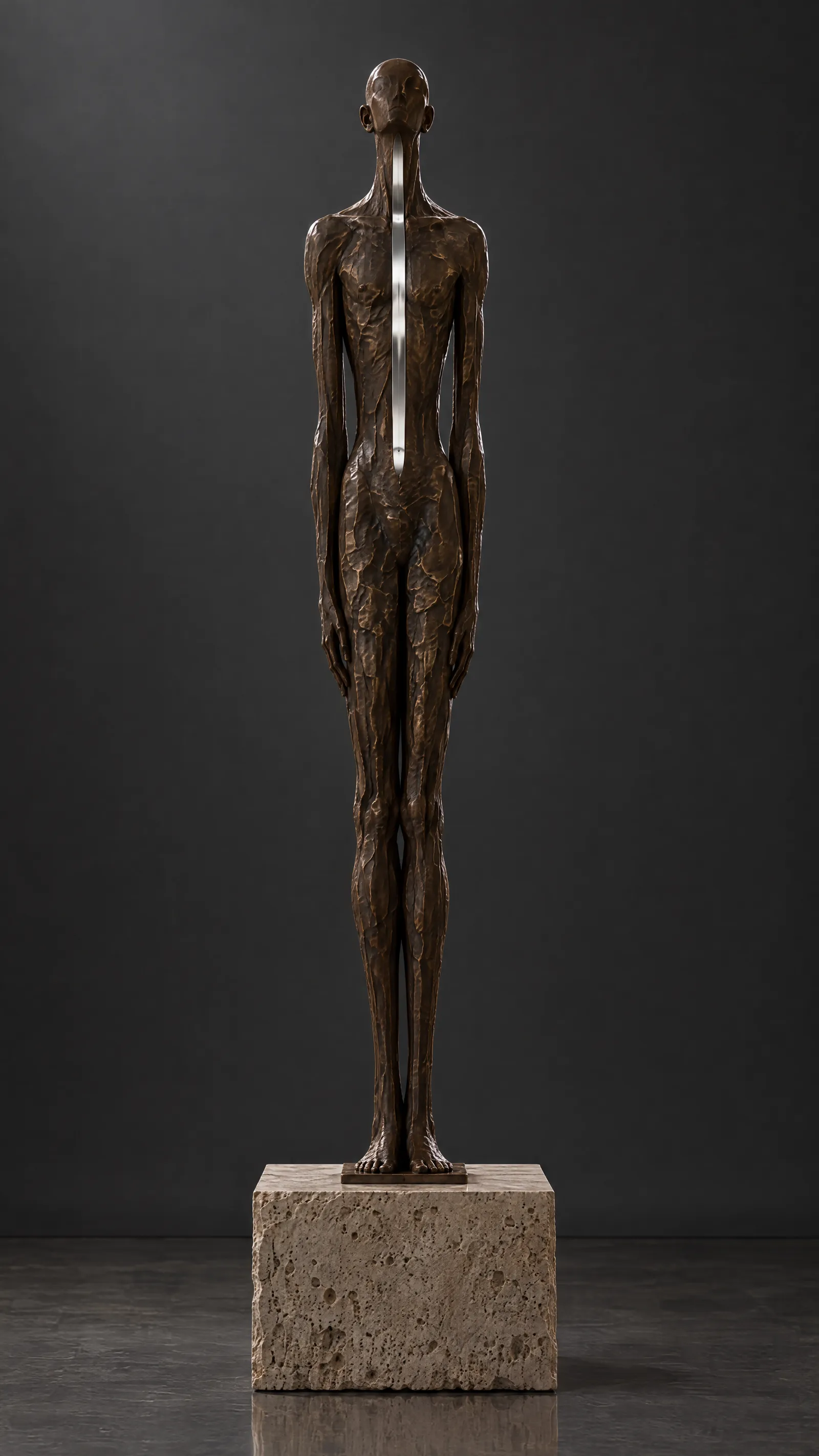
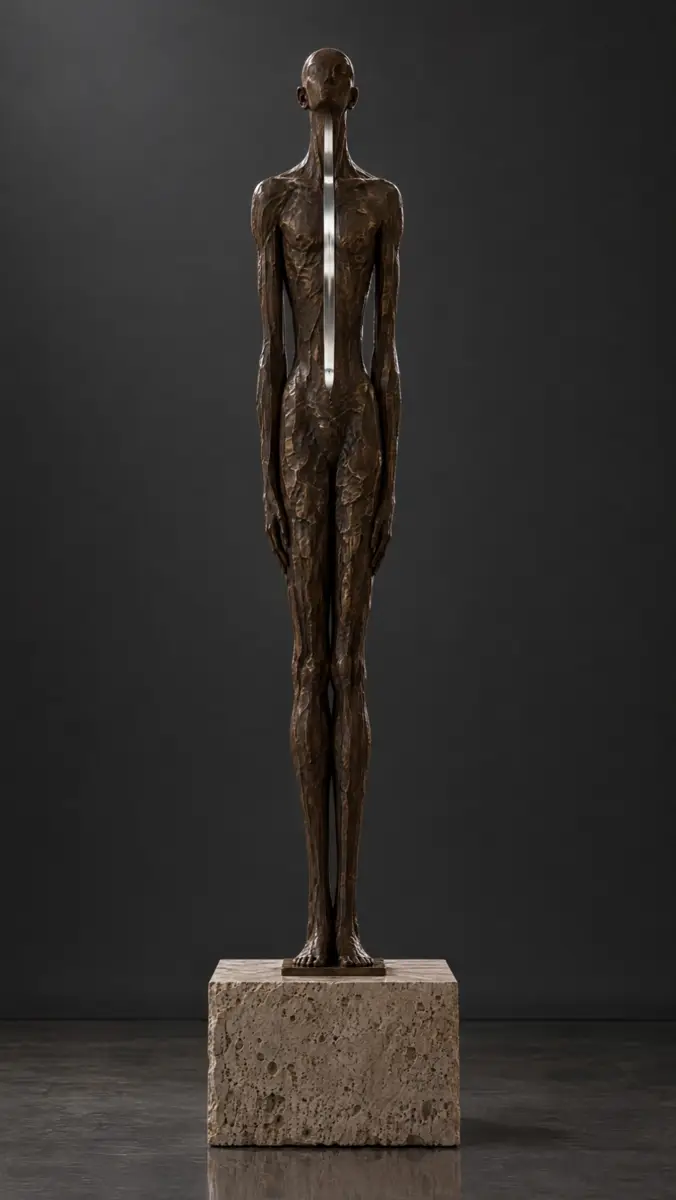
210 cm, on a travertine block of 60 × 60 × 45 cm
Material
Silicon bronze, hot patina, with a mirror-polished 316L stainless seam
Editions
Maquette 60 cm · Life 210 cm · Stainless 210 cm · Monumental 360 cm
From
The standing bronze at the glass in Clausura, A—301.05
Inquire
001 / Statement

In the Legend of the Suns the world has already ended four times. To begin the fifth, Quetzalcoatl goes down into Mictlan, the place of the dead, and asks its lord for the bones of the people who lived before. The lord of the dead makes him pay for them and tries to trick him out of them. He drops them in the dark and they break, which the story gives as the reason people are not all one size. The goddess Cihuacoatl grinds what is left in a jade bowl. The gods let their own blood onto the meal, and from it people rise. They are called macehualtin, the deserved: the ones who had to be paid for.

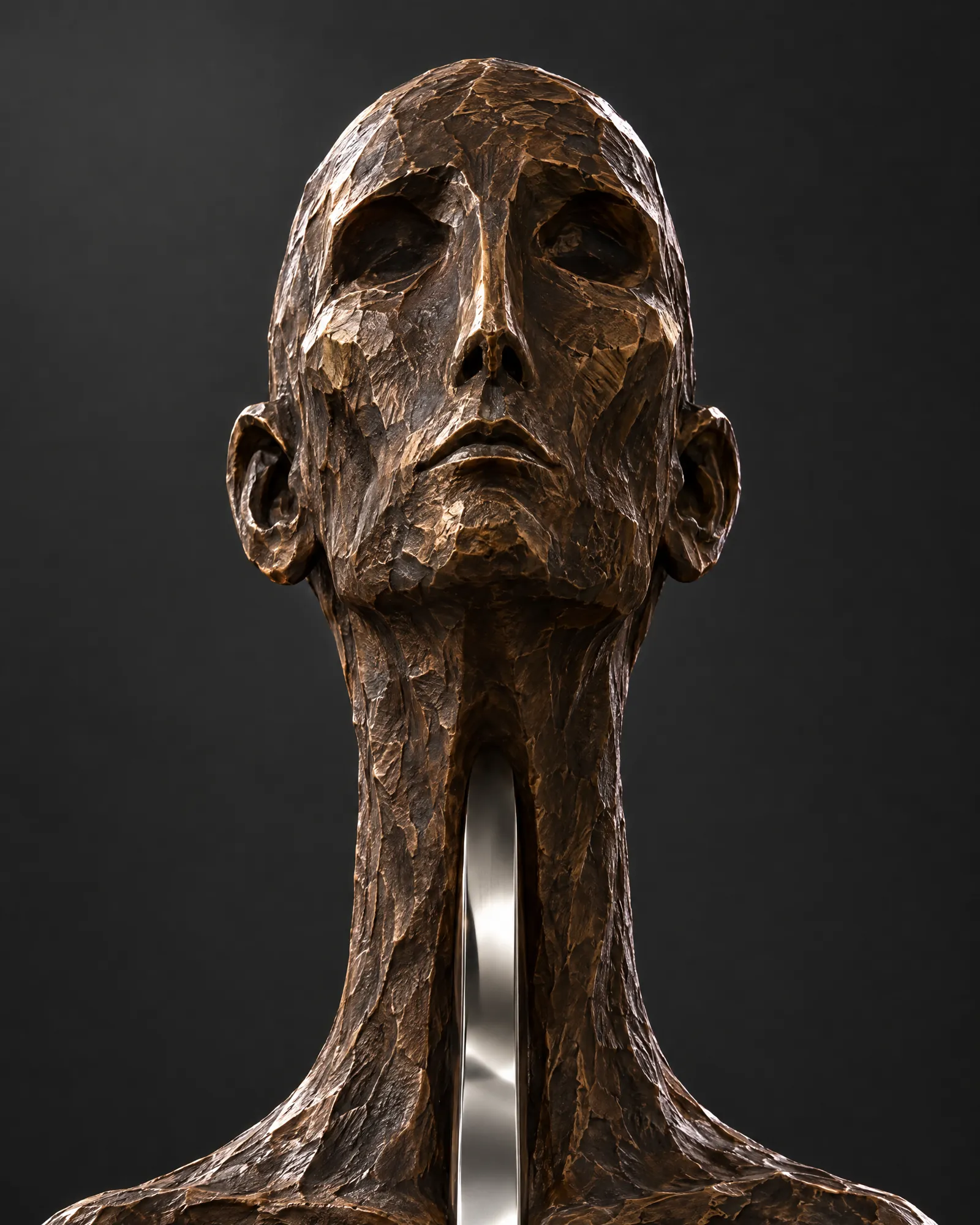
Macehualli stands in the moment after that. He is made of old matter. The bronze is hacked and built up in fragments, like bone meal pressed back into a body, and it is dark with the colour of the ground he came out of. He has only just begun to lift his head. Down the front of him, from the hollow of the throat to the navel, runs the one thing in him that is not earth: a single seam of mirror. It is the blood he was made with.

Stand in front of him and look for his maker in that line, and you will find someone looking back.

Whose face is in the seam depends on who stands there. In the house he was made for, he faces a river valley and nobody stands in front of him, so the seam holds only the sky. Anywhere else it holds whoever comes close enough to ask. The piece does not say whether the maker it shows is his, yours, or the same one. It says only that one line of him was never clay.
002 / Views

Four elevations

From the front the seam catches the light. From the back there is only the spine. Seen in profile, the chin rises a few degrees above level. Select any view to open it full size.

003 / The Body

Up close

Select a point on the figure to see that part of it.

The figure from the front, marked with five points to select
A—302.05

The Face

004 / Editions

Four scales, two metals

One form in four editions. The life-size bronze is the work, the maquette is where it began, and the other two are the ways it can grow.

005 / Specification

At scale

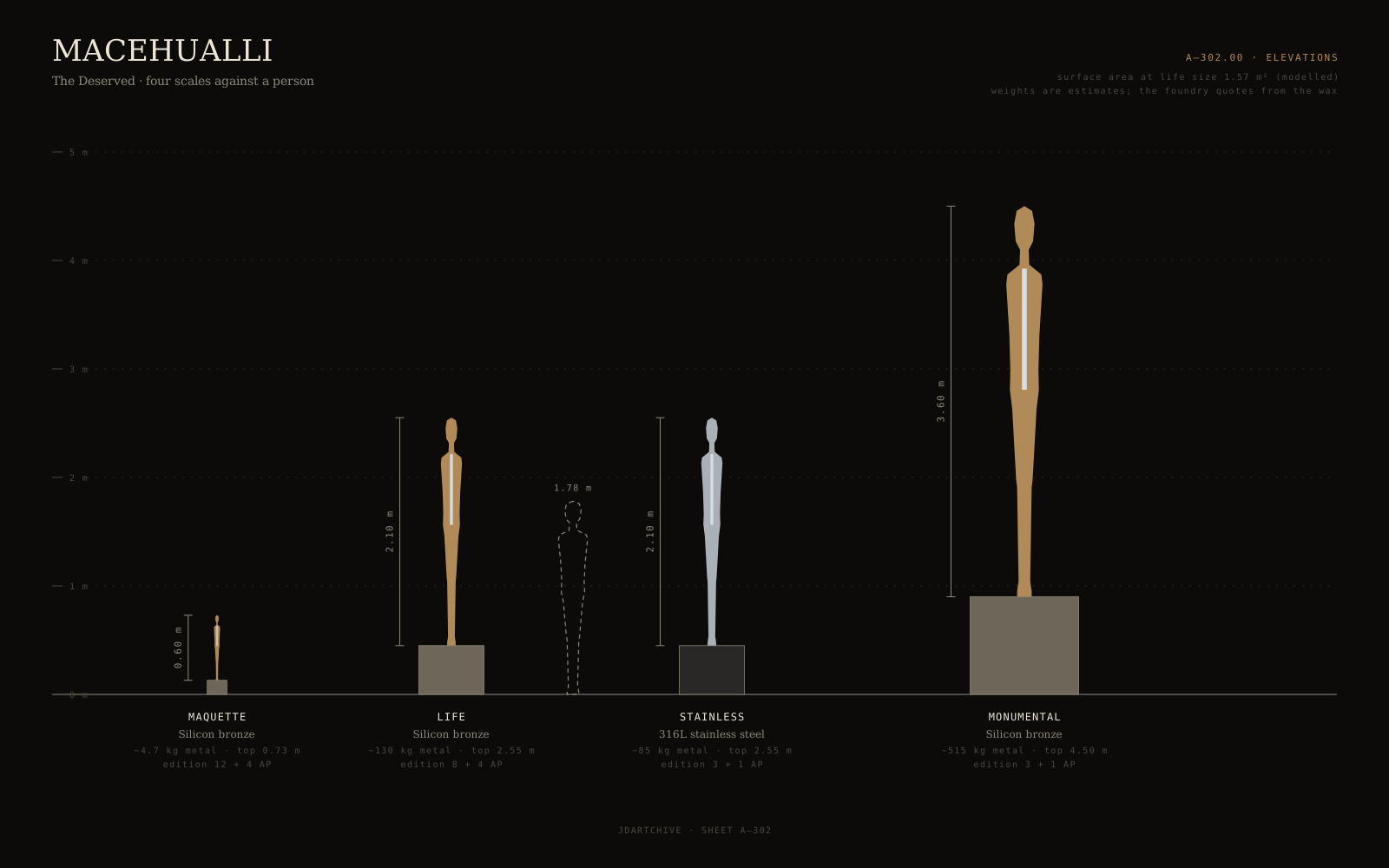
All four editions drawn to one scale against a person 1.78 m tall. Every dimension on the sheet and in the table comes from one calculation, so they cannot disagree.

Elevation sheet: the maquette, life, stainless and monumental editions drawn to one scale beside a 1.78 metre person, with heights and weights
EditionFigureMaterialWallMetalBaseInstalledFloor loadRun
Maquette0.60 mSilicon bronze4 mm~4.7 kgTravertine 18×18×13 cm, ~10.3 kg~15.1 kg, top at 0.73 m4.6 kN/m²12 + 4 AP
Life2.10 mSilicon bronze9 mm~130 kgTravertine 60×60×45 cm, ~395 kg~530 kg, top at 2.55 m14.4 kN/m²8 + 4 AP
Stainless2.10 m316L stainless steel6 mm~85 kgBasalt 60×60×45 cm, ~470 kg~555 kg, top at 2.55 m15.1 kN/m²3 + 1 AP
Monumental3.60 mSilicon bronze12 mm~515 kgTravertine 100×100×90 cm, ~2205 kg~2720 kg, top at 4.50 m26.7 kN/m²3 + 1 AP

Estimates. Surface area modelled from primitives at 1.57 m² for the life-size figure and scaled by the square of height; metal = area × wall × density (silicon bronze 8.5, 316L 8.0 t/m³) plus 8% for armature, sole-plate and studs. The life-size piece puts about 14.4 kN/m² on its footprint, against a typical 4–5 kN/m² design load for gallery floors: have the slab checked, and expect a steel spreader plate under the block.

006 / For

Three readers

One object, read three ways. Choose yours.

What you would own

  • One numbered cast from a closed edition. The number and the foundry mark are cast into the underside of the sole-plate.
  • A certificate signed by the artist, with the edition number, the foundry, the patina record and photographs of your cast.
  • Cast to order. The edition is proposed and each piece is poured when it is commissioned, so there is no warehouse stock. The lead time is set with the foundry at commission.
  • Price on request, by edition and scale.

Living with it

  • Placement. He is made to face something. Set him looking out, towards a window, a view or the length of a room, and put where people stand in front of him, because that is what the seam is for.
  • Light. One raking key light from above and to one side brings out the facets. The seam needs a light source in front of it, or a person.
  • Care, indoors. Dust, and a coat of paste wax twice a year. Wipe the seam with a soft cloth. Never use abrasives on either metal.
  • Installation. Crated, delivered and set by two installers. The life-size edition needs the floor checked first; see the specification.