Hippo Regius · 413–426 · Twenty-two books
The City of God
De Civitate Dei contra Paganos
Rome fell, and the survivors said it fell because it had abandoned its gods. A bishop in North Africa spent the next thirteen years answering — and the answer turned into the book that gave the West linear history, a definition of a people you can still use, and a theology of hell it took fifteen centuries to argue its way out of.
Fecerunt itaque civitates duas amores duo: terrenam scilicet amor sui usque ad contemptum Dei, caelestem vero amor Dei usque ad contemptum sui.
Two loves have built two cities: love of self, to the point of contempt for God, built the earthly; love of God, to the point of contempt for self, built the heavenly.
De Civitate Dei XIV.28The Occasion
24 August 410, and the accusation that followed it
Alaric's Goths entered Rome on the twenty-fourth of August, 410, and spent three days in it. Measured against what sacking a city normally meant in the ancient world, it was restrained — three days, not a massacre; the great basilicas left standing. Measured against eight hundred years in which no foreign army had taken Rome at all, it was the end of the world.
Jerome, in his cell in Bethlehem, stopped work on Ezekiel and wrote that his voice failed him: the city which had taken the whole world was itself taken. Refugees crossed to North Africa in numbers, and they brought an argument with them. Rome had stood for eleven centuries under Jupiter, Mars and the rest. It had been Christian for less than a hundred years. Then it fell. The inference was not subtle and it did not need to be.
Augustine was fifty-nine, bishop of Hippo Regius on the Algerian coast, and he had a full job already. He started answering in 413 and put down the last book in 426. He wrote it in instalments, publishing as he went, over thirteen years, while running a diocese and fighting the Donatist and Pelagian controversies at the same time.
The dedication is a piece of evidence in itself
The book is addressed to Flavius Marcellinus, the imperial commissioner who had presided at the Conference of Carthage in 411 and who had asked Augustine, on behalf of the pagan aristocrat Volusianus, to answer the charge properly.
In September 413, while Augustine was writing Book One, Marcellinus was arrested on a false charge and executed by the imperial administration he served. Augustine had petitioned for him and failed. He left the dedication standing.
So the treatise that contains the West's sharpest analysis of what earthly power actually is opens with the name of a decent man that earthly power had just killed, for nothing, while the ink was wet. Augustine never mentions it in the book. He did not have to.
The joke he opens with
Before any argument, Augustine makes an observation that is close to unanswerable I.1–7. Alaric's Goths were Arian Christians, and they honoured the right of sanctuary: those who fled into the basilicas of Peter and Paul were spared, pagans among them. This had no precedent. Sacking armies did not historically respect the temples of gods they did not worship.
Which means, Augustine points out, that a number of the people now going about Africa explaining that Christianity destroyed Rome are alive to say so because they hid in a church. He is scathing, and he is funny, and he is not wrong.
The Architecture
Twenty-two books, and a plan the author states twice
This is not a sprawl. Augustine lays out the structure in the preface to Book One, restates it at X.32, and sets it down again decades later in the Retractationes when he reviews his own output. Ten books take something apart. Twelve build something in its place. The twelve divide into three groups of four: where the two cities came from, how they have run, and how they end.
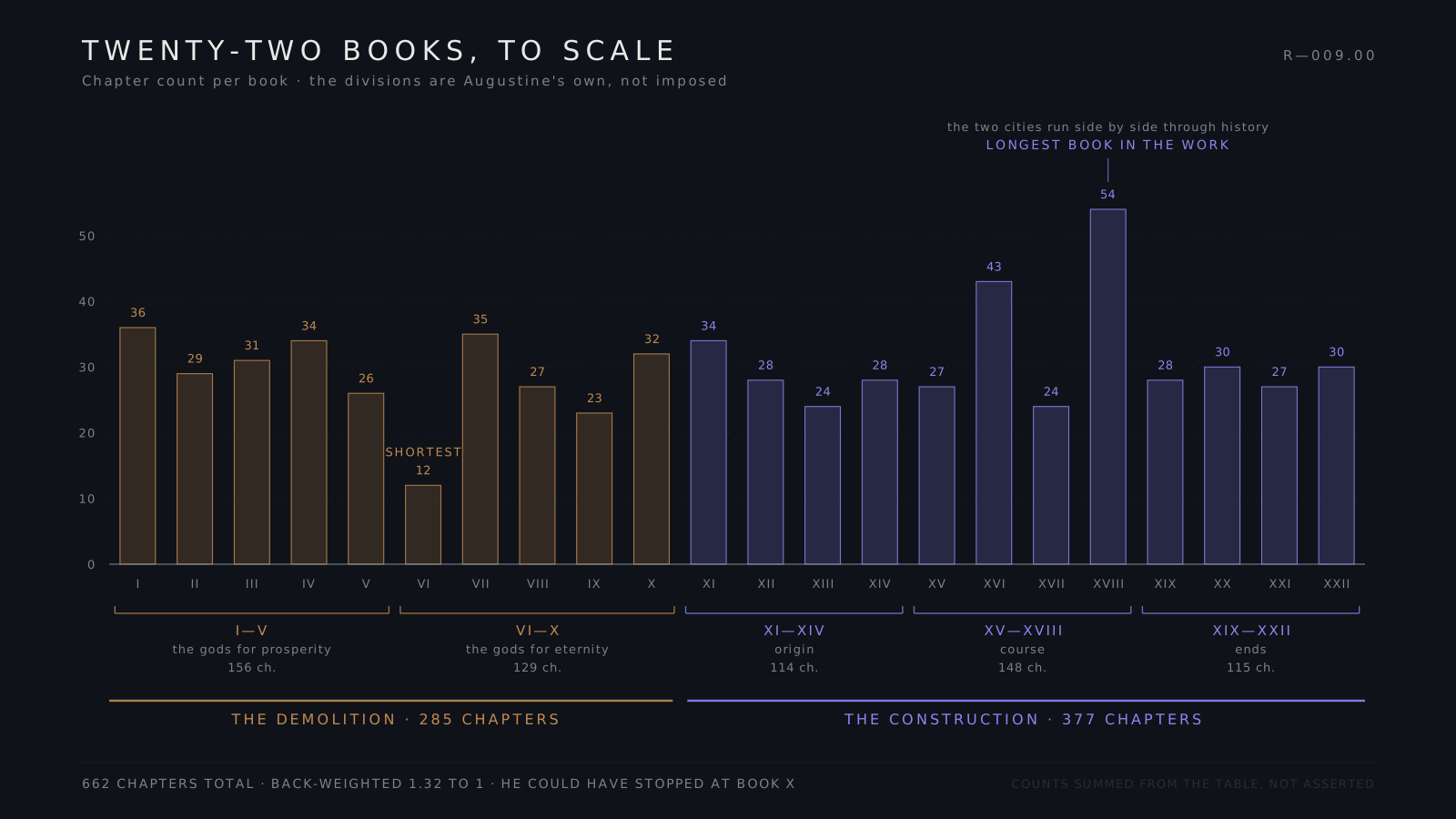
Worth saying plainly: he could have stopped at Book Ten. The commission was to answer a charge, and by Book Ten the charge is answered. The remaining twelve books are a volunteer effort — and they are the reason anyone still reads it.
The Demolition
Books I–X, in which the case against Rome is made by a Roman
The obvious move would have been to argue that Rome fell for its sins and deserved it. Augustine does something harder and much more interesting: he grants Rome its virtues, in detail and with evident admiration, and then asks what those virtues were for.
The pirate
The most famous forty words in the book are in IV.4, and they are a question rather than a claim.
Remota itaque iustitia quid sunt regna nisi magna latrocinia?
Set justice aside, then, and what are kingdoms but large-scale robbery?
De Civitate Dei IV.4
He follows it with the story of the captured pirate brought before Alexander. Asked what he meant by seizing the sea, the man answers: the same thing you mean by seizing the whole earth — but because I do it with one small ship I am called a robber, and because you do it with a great fleet you are called an emperor.
Augustine does not editorialise. He reports the answer as eleganter et veraciter — elegant and true — and moves on. The argument is structural, not moral posturing: if the thing that separates an empire from a criminal gang is justice, then justice had better be something you can actually locate, and Books XIX will come back and ask whether Rome could locate it.
Roman virtue was real, and it was paid in full
Books IV and V are where a lesser polemicist would have cheated. Augustine does not. He goes through the Roman heroes — Regulus, Brutus, the Scaevolas, Cato — and grants that their self-denial was genuine and their discipline extraordinary V.12–18. He argues that God gave them their empire deliberately, as a real reward for real virtue.
Then he closes the trap. What they loved was gloria — praise, reputation, the good opinion of men. They wanted to be spoken well of, and they were, and they are still. They have received their wages. The virtues were real; the payment was earthly; the account is settled and closed. It is a far more devastating reading than calling them hypocrites, because it takes them at their highest and shows the ceiling.
He does not accuse Rome of failing its own standard. He accepts that Rome met it, and asks what the standard was worth.
The lust for domination
Running underneath all ten books is a phrase Augustine puts in the very first paragraph and never lets go of: libido dominandi, the lust for mastery. His formulation is that Rome is a city which rules the nations and is itself ruled by that lust. The ruler is the possessed one. It is a diagnosis of empire as a compulsion rather than an achievement, and it is placed before any theology, where the reader cannot skip it.
What he does with the raped women, which is the part nobody expects
In the sack, Christian women were raped, and afterwards some were being told — and were telling themselves — that the honourable course was suicide, on the model of Lucretia. Augustine takes eleven chapters on this I.16–28, and his conclusion is unambiguous: chastity is a disposition of the will, and a body violated without the will's consent is not defiled. No guilt attaches. Suicide is forbidden, and the pressure to commit it is an additional injury.
He then turns on the Lucretia story with real anger I.19. If she was innocent, Rome praised a woman for killing an innocent. If she was not, there is nothing to praise. The Roman honour code, he argues, killed her twice, and the women of Hippo owe it nothing.
Written by a fifth-century bishop, to women in his own congregation, in a culture where the alternative was being quietly counselled to die. It is the most humane passage in the book, and it is in Book One.
The Construction
Books XI–XXII, and the two cities
Having cleared the ground, Augustine proposes that all of human history is the intertwined story of two communities that are not countries, not institutions and not visible — and that the only thing separating them is what they love.
It is a strange and enormously productive idea, and its strangeness is easy to miss because the phrase has been worn smooth. The two cities are not two places, two eras, two classes, or two organisations. They are two orientations of desire, each of which has produced a society running through time. A person belongs to one of them by what they ultimately love, and nobody can reliably read that off anybody, including themselves.

The refusal that matters most
The City of God is not the Church. The earthly city is not the Roman state. Augustine says so, repeatedly and with some irritation. The visible Church is a corpus permixtum, a mixed body containing members of both cities; the empire is a human institution which can be relatively better or worse and which both cities use.
This single refusal is what makes the book durable and what makes it constantly misquoted. It blocks theocracy, because the Church cannot claim to be the heavenly city. It blocks the identification of any nation with God's purposes, because no polity can be that. And it blocks the cynical reading, because the earthly city is not simply "politics" — it is a spiritual orientation that runs straight through the Church as well.
He kills the wheel
The learned world Augustine was arguing with mostly held that time is cyclical — the Great Year, the return of all things, the same events recurring without end. Against this he spends XII.13–20 arguing, and his lever is a single historical event: Christ died once, and does not die again.
If one event is genuinely unrepeatable, the wheel is broken and time is a line. It is difficult to overstate what follows from this. The idea that history is a story going somewhere — rather than a wheel — enters the West here, and every subsequent doctrine of progress, including the thoroughly secular ones, is drinking from a well this book dug. Augustine would have been appalled by most of them.
What a people is
Book XIX contains the passage that political theory has never quite got over. Cicero, in the Republic, had defined a commonwealth as the affair of a people, and a people as a multitude united by a shared acknowledgement of right and by common interest. Justice is load-bearing in that definition.
Augustine takes the definition seriously enough to apply it XIX.21. If true justice means giving each his due, and the first due is God's, then a society that does not render it has no justice; without justice there is no right; without right, no people; without a people, no commonwealth. Conclusion, stated flatly: on Cicero's own definition, Rome was never a commonwealth at all.
And then, rather than leaving the rubble, he offers a replacement XIX.24 — and the replacement has no justice in it:
Populus est coetus multitudinis rationalis rerum quas diligit concordi communione sociatus.
A people is a gathering of a rational multitude, united by sharing in agreement on the things it loves.
De Civitate Dei XIX.24
By this definition Rome was a people. So is Athens, so is Assyria, and so is a criminal gang. The definition is deliberately cheap to satisfy. Its power is what it does next: if you want to know what a society is, look at what it agrees to love, and the better the objects of its love, the better the people. He has converted a yes/no question into a scale, and the scale measures something a state cannot legislate.
Peace, which is what everything is doing
The deepest claim in the book is in XIX.11–13, and it is easy to read past. Augustine's definition:
Pax omnium rerum tranquillitas ordinis.
The peace of all things is the tranquillity of order.
De Civitate Dei XIX.13
Then the move. Everything that exists wants peace, including everything that appears to want the opposite. Wars are fought to reach a peace on better terms. Robbers demand peace inside their own band, and enforce it. The man who breaks every rule around him still requires order in his household, and is enraged when he does not get it. Even the most violent creature wants its own body and its own den at rest.
There is no second goal. Nobody is pursuing chaos; chaos is not a thing anyone can want. Evil, on this account, is not an alternative destination but a badly ordered route to the only destination there is. It is the same structural idea as his account of the evil will at XII.7, which has no efficient cause but only a deficient one — a falling-away rather than a thing. To look for the cause of an evil will, he says, is like trying to see darkness or hear silence.
The judge who has to torture
One more passage from Book XIX deserves its own paragraph, because it is startlingly modern and almost nobody quotes it. At XIX.6 Augustine considers the Roman judge who, to establish the truth, must have witnesses tortured — including witnesses who may be innocent, who may confess falsely under pain, and who may then be executed on that confession.
He does not say the judge should refuse the office; he thinks society needs judges. He says that the wise man will take the seat, and will call it not wickedness but necessity, and that this is precisely the problem. His conclusion is not a resolution. It is that the judge, if he has any awareness at all, should cry out to God to be delivered from his necessities. The system is not defended and not escaped. It is confessed.
The last chapter
Twenty-two books, thirteen years, and the end of it is not a triumph. It is XXII.30, on the seventh age, the sabbath that does not end:
Ibi vacabimus et videbimus, videbimus et amabimus, amabimus et laudabimus. Ecce quod erit in fine sine fine.
There we shall be still and shall see; we shall see and shall love; we shall love and shall praise. Behold what shall be, in the end, without end.
De Civitate Dei XXII.30
The whole enormous structure — the polemic, the history, the metaphysics, the hell — resolves onto four verbs and rest. The book that began with a sacked city ends with the word for having nothing left to do.
What It Cost
The parts a sympathetic reading usually walks past
A reading that takes Book XIX's account of peace and leaves Book XXI in the dark is not a reading, it is a sales brochure. The same mind produced both, in the same work, deliberately and at length, and the second has had at least as much effect on history as the first.
Held against the book, not excused
Twenty-seven chapters arguing that the punishment of the damned is bodily, conscious and eternal — constructed specifically to refute the misericordes, the tender-hearted Christians who hoped it might end. Augustine works through their arguments one at a time and closes each. The doctrine was available before him; the West's confidence in it is substantially his.
He concludes that unbaptised infants are damned, assigning them the mildest punishment of the condemned. He reached it by argument from premises he held, and he did not flinch from it. It is the clearest case in his work of a conclusion that should have been treated as a refutation of the premises.
Humanity as a massa damnata from which a fixed number are elected, the rest justly left. The population of the heavenly city is, on this account, settled in advance. Later Augustinianism — Gottschalk, Calvin, Jansenius, and the wars that came with them — is downstream of this and not a distortion of it.
Not in this book, but by the same hand in the same years: in the Donatist conflict Augustine moved from opposing state coercion in religion to endorsing it, reading compelle intrare — compel them to come in — as warrant. He argued it carefully and he was persuasive, and it was cited for more than a thousand years by people doing considerably worse things than he had in mind. It is the darkest thing he did, and it is his.
Book XIV's treatment of desire after the fall — sexual arousal as the standing evidence that the will no longer governs the body — is subtler than the caricature and more damaging than its defenders allow. A great deal of Western unease about the body traces to this chapter and the reading habits it formed.
None of that is a reason not to read it. It is a reason to read it as what it is: a working mind of the first order, operating at full power, arriving at some of the most useful ideas in Western thought and some of the most harmful, by the same method, in the same book, without a seam you can cut along. The seam is not there. That is the actual lesson.
What Survived
And what the book still does that nothing has replaced
Time became a line
The rejection of eternal recurrence is the single most consequential paragraph-cluster in the work. Once history has a direction and unrepeatable events, you can have progress, decline, development, revolution and deadlines. Every secular philosophy of history in the West is built on a foundation poured here by a man arguing about the resurrection.
A polity stopped being able to claim ultimacy
By refusing to identify either city with any visible institution, Augustine opened a permanent gap between the state and the absolute. That gap is where the distinction between spiritual and temporal authority grew, and eventually where the secular state grew. He was not trying to invent it.
A usable test for a society
"Look at what it agrees to love" survives translation out of theology completely intact. It is a better diagnostic than most political science offers, because it asks about revealed preference at the collective level and does not care what the constitution says.
The refusal to let anyone sort the room
Permixtae. Nobody gets to identify the wheat. This is the part most often dropped by people who want the book's authority, and it is load-bearing: strip it out and you get exactly the theocratic and nationalist readings Augustine wrote it to prevent.
- c. AD 800 · AachenCharlemagne had it read aloud at his table — Einhard names it as the book he liked best. The emperor who built his capital on a hot spring took his dinner to the sound of a treatise on why empires are not ultimate.
- 1517–1564 · Wittenberg, GenevaLuther was an Augustinian friar by rule and Calvin by conviction; the Reformation is in large part an argument about which Augustine was the real one.
- 1929 · HeidelbergHannah Arendt's doctoral dissertation was on the concept of love in Augustine, under Jaspers. The categories of natality and worldliness she is famous for were forged on this material first.
- Twentieth century · the academy"Augustinian realism" in international relations is largely a misreading — it keeps the pessimism about power and discards the permixtio and the eschatology that make the pessimism bearable and coherent.
- 430 · Hippo RegiusFour years after finishing it, Augustine died at seventy-five with the Vandals camped outside his own city walls. Hippo fell the following year and was burned. He had written the definitive book about the fall of a city and then watched his own come.
He spent thirteen years explaining that no city is permanent, and was given a demonstration.